

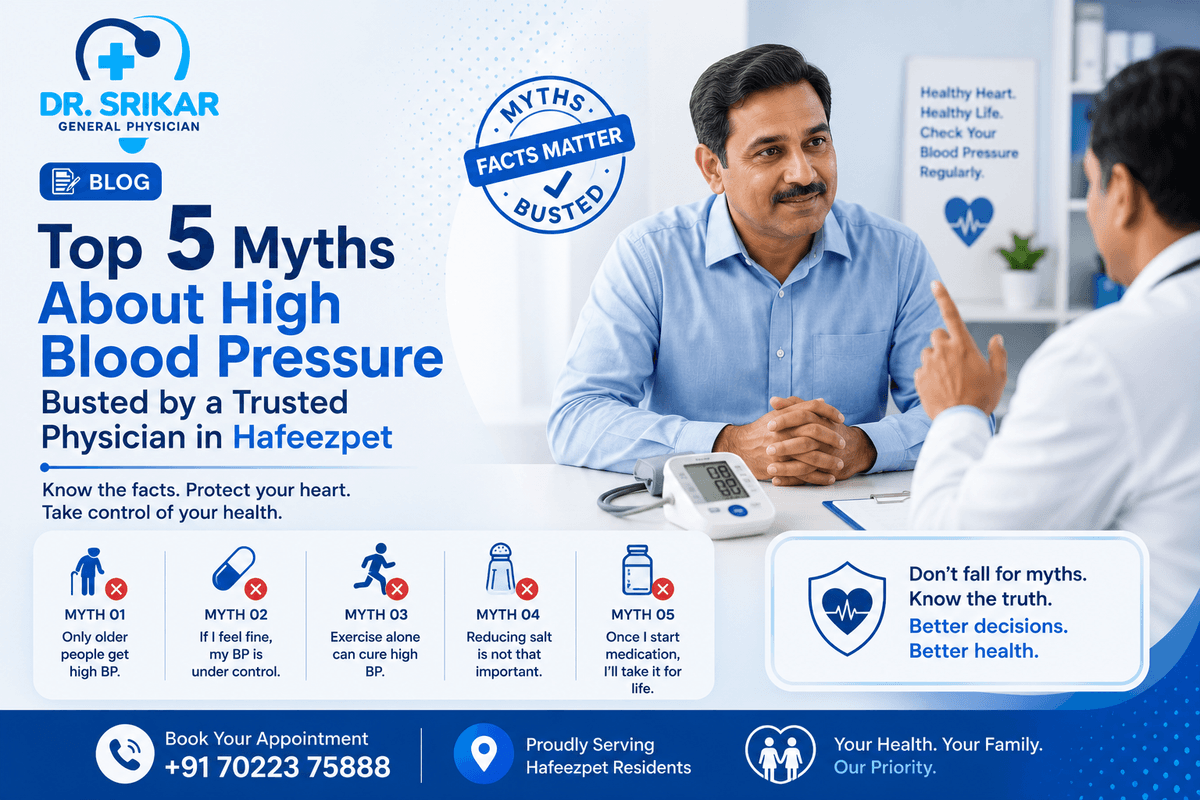
Top 5 Myths About High Blood Pressure Busted by a Trusted Physician in Hafeezpet
"My BP Was Fine Last Month — I Don't Need to Check Again"
If you've ever said something like this, you're not alone. Every day, residents across Hafeezpet walk into Dr. Srikar's clinic saying they feel perfectly fine — only to discover their blood pressure is dangerously elevated. The most harmful thing about high blood pressure is not what it does to your body, but what it doesn't do: it gives you no warning.
High blood pressure affects nearly one in three adults in India, yet many people are unaware that they have it. This condition is often called "the silent killer" because it usually develops without noticeable symptoms, all while slowly damaging the heart, blood vessels, and other vital organs.
Myths and misconceptions about hypertension are everywhere — in WhatsApp forwards, casual chai-time conversations, and even well-meaning family advice. These myths lead people to delay treatment, skip medication, or believe they are safe when they are not. As a trusted physician in Hafeezpet, Dr. Srikar sees the real-world consequences of these myths every single week. This blog busts the five most dangerous ones, once and for all.
The Direct Answer: Yes, You Could Have High BP Right Now and Feel Nothing
Hypertension is a silent killer — very rarely can any symptom be seen in its early stages until a severe medical crisis occurs, like heart attack, stroke, or chronic kidney disease. The only way to detect hypertension is to have a health professional measure blood pressure.
The reason myths persist is simple: people expect illness to feel like illness. But hypertension operates in the background — silently, steadily — until something breaks.
The fact is, most people feel nothing at all. Hypertension is often diagnosed incidentally, during routine check-ups or preoperative tests.
With that truth established, let's tackle the five most common myths that Dr. Srikar encounters at his Hafeezpet clinic.
5 Myths About High Blood Pressure — Busted
🔴 Myth #1: "I Would Know If My Blood Pressure Was High"
BUSTED. This is the most dangerous myth of all.
Many people believe you will know when your blood pressure is high. Most people will not. Hypertension rarely announces itself through headaches or dizziness the way many assume. Many people only find out during a routine check-up.
Headaches and flushing can occur, but they are unreliable indicators. The only way to know your BP is to check it. Dr. Srikar recommends all adults in Hafeezpet above the age of 25 get their blood pressure checked at least once a year — even if they feel completely healthy.
🔴 Myth #2: "Hypertension Only Affects the Elderly"
BUSTED. Age is a risk factor, but youth is not a shield.
Young adults and even children can develop hypertension, particularly when poor eating habits, obesity, chronic stress, smoking, or heavy drinking are part of the picture.
Over 230 million Indians suffer from high blood pressure, of which over 11% lie between the ages of 15 to 49 years. The younger generation today is succumbing to fast-paced and stressful lives and is hence at risk of developing high blood pressure.
With Hafeezpet being a fast-growing tech-hub locality, many residents lead sedentary, high-stress lifestyles — a recipe for early-onset hypertension.
🔴 Myth #3: "I've Cut Table Salt, So My Blood Pressure Is Under Control"
BUSTED. Cutting table salt is a good first step — but it barely scratches the surface.
Many believe that avoiding table salt alone is enough to control blood pressure. While cutting table salt is a good step, it is only part of the story. Packaged soups, sauces, chips, and ready-to-eat meals carry significant amounts of hidden sodium that most people never account for. Reading labels and eating more fruits, vegetables, and whole grains makes a bigger difference than just stopping adding extra salt to your food.
Modifiable risk factors for hypertension include unhealthy diets, physical inactivity, consumption of tobacco and alcohol, being overweight or obese, increased waist circumference, and having high glucose levels.
Managing blood pressure requires a holistic approach — not just one dietary change.
🔴 Myth #4: "My BP Is Normal Now, So I Can Stop My Medication"
BUSTED. This is one of the most medically dangerous myths Dr. Srikar encounters.
You will likely have to take medicine every day for the rest of your life. Medication can get blood pressure under control, but stopping medication will likely cause blood pressure to rise again.
Tampering with and reducing drugs or stopping them should never be done unless the treating doctor advises.
Your readings are normal because the medication is working — not because the problem has gone away. Always consult your physician before making any changes to your BP medication.
🔴 Myth #5: "Lifestyle Changes Alone Can Cure Hypertension"
BUSTED. Lifestyle changes are powerful and necessary, but for most patients, they are not a cure.
While exercise, a low-sodium diet, stress management, and quitting tobacco absolutely help reduce blood pressure,
if hypertension is left untreated, it can affect all organ systems and can considerably shorten one's life expectancy by 10 to 20 years.
For patients with established hypertension, lifestyle changes complement — but rarely replace — medical treatment. Your physician will tailor a plan that may combine both approaches for your specific numbers and risk profile.
How Dr. Srikar's Clinic in Hafeezpet Can Help
At Dr. Srikar's clinic in Hafeezpet, managing high blood pressure is not a one-size-fits-all prescription. Patients from across Hafeezpet receive a thorough consultation that includes accurate blood pressure measurement, lifestyle assessment, and a personalised management plan. Whether you're newly diagnosed, struggling with medication adherence, or simply want a reliable routine check, Dr. Srikar provides clear, evidence-based guidance that cuts through the myths.
The clinic offers:
- Accurate BP screening using calibrated equipment
- Personalised diet and lifestyle counselling tailored to Indian eating habits
- Medication review — ensuring you're on the right drug, at the right dose
- Regular follow-up monitoring to track your progress
- Friendly, unhurried consultations in the heart of Hafeezpet
You don't need to wait for a health scare to take action. A 15-minute check-up with a trusted physician in Hafeezpet could be one of the most important things you do this year.
Evidence: Why This Matters So Deeply in India
The numbers paint a sobering picture.
The ICMR-INDIAB study reports a huge and alarming hypertension prevalence of 311 million people in India, with an overall prevalence of 30.7 percent — meaning one in every three adults in India is hypertensive.
According to the Global Burden of Disease study, in 2019, high blood pressure was responsible for approximately 1.6 million deaths in India, accounting for 14.1% of total deaths.
Yet,
an estimated 20 crore (200 million) people in the country are affected by hypertension, yet according to government statistics, only 2 crore (20 million) have their condition under control.
Only 12% of people with hypertension have self-monitoring devices and, hence, have their levels under control.
These statistics mean that the majority of people living with hypertension — potentially including your neighbours in Hafeezpet — are undiagnosed, undertreated, or managing the condition on the basis of myths rather than medical fact. Dr. Srikar's mission is to change that, one patient at a time, right here in Hafeezpet.
Frequently Asked Questions (FAQs)
Q1: Can stress alone cause permanent high blood pressure? Stress can cause temporary spikes in blood pressure, but it is unlikely to cause permanent hypertension on its own. However,
in India, stress and unhealthy lifestyle habits are among the most significant contributors
to the condition. Chronic stress combined with poor diet, inactivity, and inadequate sleep significantly raises your long-term risk.
Q2: How often should I check my blood pressure in Hafeezpet if I'm over 40? If you are over 40 and living in Hafeezpet, Dr. Srikar recommends getting your blood pressure checked at least every 6 months, even if your previous readings were normal.
The prevalence of hypertension increases sharply with age for both women and men,
making regular screening at this life stage non-negotiable.
Q3: Is it safe to use a home BP monitor instead of visiting a doctor? Home monitoring is a helpful tool, but it should not replace professional evaluation.
The only way to detect hypertension is to have a health professional measure blood pressure. Although individuals can measure their blood pressure using automated devices, an evaluation by a health professional is important for assessing risk and associated conditions.
Q4: Can high blood pressure be reversed completely? In some cases — particularly where hypertension is secondary to another treatable condition — BP can normalise after treatment. However, for the vast majority of patients with primary hypertension,
medication may need to be taken every day for life. Medication can get blood pressure under control, but stopping medication will likely cause blood pressure to rise again.
The goal is long-term control, not a "cure."
Q5: What are the warning signs that my BP has reached a dangerous level?
Mostly, there are no symptoms, or sometimes minor symptoms, but hypertension damages the arteries and vital organs of the body, which can lead to life-threatening medical emergencies.
Severe, sudden headache, blurring of vision, chest pain, or difficulty breathing may indicate a hypertensive crisis — seek emergency medical care immediately and do not wait for symptoms to pass.
Visit Us
Don't let myths put your health at risk. Dr. Srikar's clinic is right here in Hafeezpet — take the first step toward knowing your numbers and protecting your future.
Dr Srikar Hafeezpet