

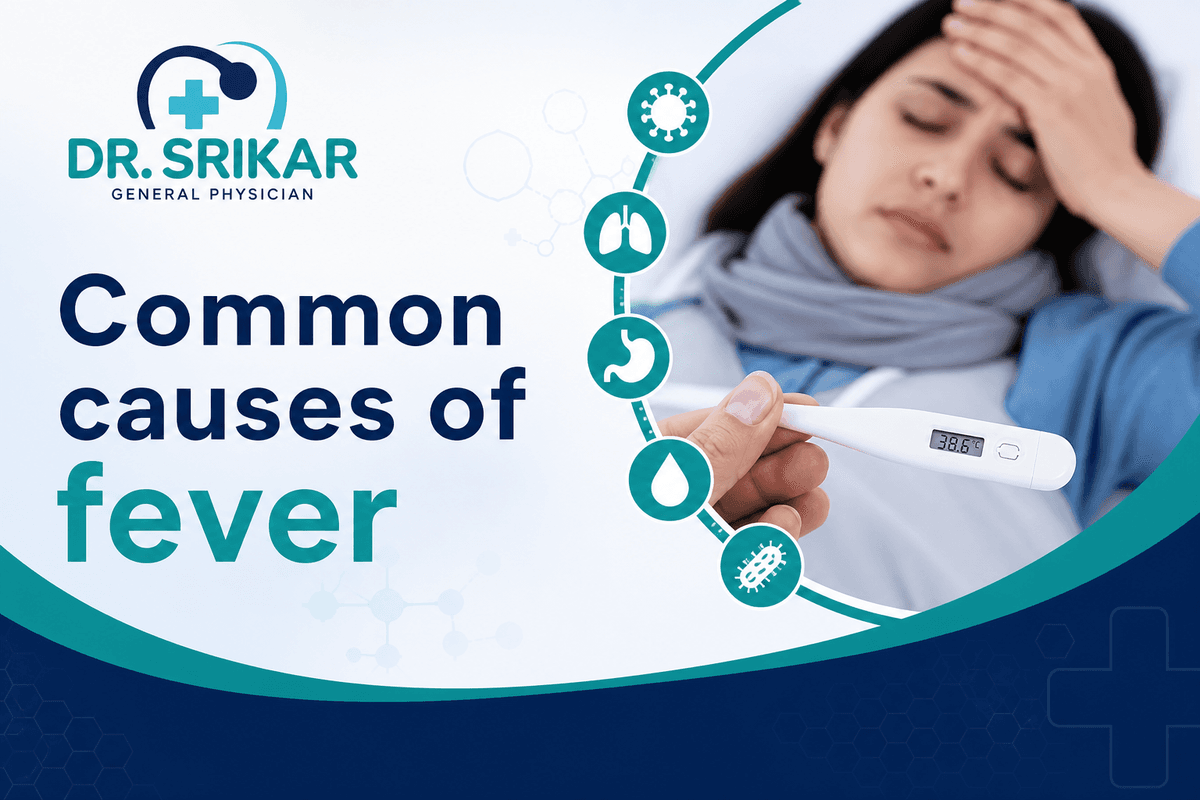
Common Causes of Fever You Shouldn't Ignore — A Guide for Residents of Hafeezpet
By Dr. Srikar | General Physician, Hafeezpet
The Problem: That "It's Just a Fever" Assumption Could Be Dangerous
It happens all the time in Hafeezpet. A family member wakes up with a high temperature, body aches, and chills. Someone rushes to the nearest medical store, buys a paracetamol strip, and says, "It's just a fever — rest a couple of days and you'll be fine."
Sometimes, that's true. But sometimes, it isn't.
Fever is a common health issue in India, affecting millions every year. Importantly, it is a symptom rather than a disease itself, often indicating an underlying infection or medical condition.
With a wide range of fever causes including viral, bacterial, and mosquito-borne diseases, understanding the different types of fever is essential for timely diagnosis and treatment.
The stakes are especially real in Hyderabad and its fast-growing suburbs like Hafeezpet. Telangana witnessed its worst outbreak of seasonal diseases in 2024, with an alarming surge in dengue and chikungunya cases. For the first time, the state reported 13,592 suspected chikungunya cases and 10,077 confirmed dengue cases, making 2024 a year of serious public health concern.
Treating every fever as "routine" is a gamble. Knowing why you have a fever is the only way to treat it correctly — and that starts with seeing the right doctor at the right time.
The Answer: What Actually Causes Fever?
The medical term for fever is "pyrexia." It is a temporary rise in body temperature, usually in response to an infection, inflammatory condition, or immune response. Normal body temperature ranges from 97°F to 99°F (36.1°C to 37.2°C), and a fever occurs when body temperature rises above 100.4°F (38°C).
Here are the most common causes of fever seen in patients across India, including those visiting our clinic in Hafeezpet:
1. Viral Infections (Most Common)
Common causes of acute fever include viral infections such as influenza and the common cold, bacterial infections like strep throat and UTI, as well as gastrointestinal and respiratory infections. These typically resolve within 3–5 days with rest and fluids.
2. Dengue Fever
Dengue fever is caused by the dengue virus, transmitted to humans primarily through the bite of Aedes mosquitoes, particularly Aedes aegypti. These mosquitoes thrive in urban areas, breeding in stagnant water found in containers like buckets, flower vases, and discarded tires. Symptoms typically include high fever, severe headache, pain behind the eyes, joint and muscle pain, rash, and mild bleeding manifestations like nosebleeds or gum bleeding.
3. Typhoid Fever
Bacterial infections such as typhoid, urinary tract infection (UTI), pneumonia, and tuberculosis are common causes of fever in India. In 2017, more than half the cases of typhoid fever worldwide were projected to have occurred in India.
4. Malaria & Chikungunya
Malaria and dengue are among the most common causes of acute undifferentiated fever in India, particularly in tropical, urban regions. Chikungunya, a vector-borne disease, causes severe joint pain and fever and has been surging in Telangana.
5. Urinary Tract Infections (UTIs) & Other Bacterial Causes
UTIs, pneumonia, and skin infections are frequently overlooked fever triggers, especially in women, the elderly, and diabetic patients.
6. Drug-Induced & Autoimmune Causes
Medical experts assert that fever can be caused by viral or bacterial infections, heat exhaustion, inflammatory conditions like rheumatoid arthritis, and can also arise as a side effect of certain medications like antibiotics and some drugs used in the treatment of hypertension or seizures.
The Solution: How Dr. Srikar's Clinic in Hafeezpet Helps You
If you live in Hafeezpet or the surrounding areas and are experiencing fever, you don't need to travel far to get accurate answers. At Dr. Srikar's general physician clinic in Hafeezpet, we take a structured, evidence-based approach to diagnosing and managing fever — because the right treatment depends entirely on the right diagnosis.
Here's what a visit with Dr. Srikar typically involves:
Step 1 — Clinical Assessment A thorough history including duration of fever, pattern (continuous, intermittent, or relapsing), associated symptoms like rash or joint pain, and recent travel. Due to the similar clinical presentations of many tropical fevers, effective disease management demands expertise in the etiology and local epidemiology of these infections.
Step 2 — Targeted Investigations Investigations may include blood tests (CBC, ESR, CRP) to check for infections or inflammation, urine tests for UTI, chest X-ray for pneumonia or TB, and specific tests for malaria, dengue, typhoid, or autoimmune conditions.
Step 3 — Accurate, Cause-Specific Treatment Fever treatment typically involves antipyretics like paracetamol, hydration, and rest. For bacterial infections, antibiotics may be required, while viral fevers may need antiviral medications.
Step 4 — Follow-Up & Monitoring Fever patterns change. Dengue platelets can drop rapidly. Typhoid can worsen without antibiotic compliance. Our clinic in Hafeezpet ensures patients are monitored closely so complications are caught early.
Residents from Hafeezpet, Miyapur, Madhapur, Chandanagar, and HITEC City can access same-day consultations at the clinic — no long hospital queues, no guesswork.
The Evidence: Why Timely Diagnosis Matters
The data from Telangana and broader India makes a compelling case for taking fever seriously:
For the first time, Telangana reported 13,592 suspected chikungunya cases and 10,077 confirmed dengue cases in 2024, placing the state second in South India — after Karnataka — in total dengue and chikungunya cases between January 2024 and January 2025.
Hyderabad emerged as the worst-hit area, accounting for 2,731 of the state's dengue cases, making it the district with the highest incidence in the state.
A North India study found that infections accounted for 50.8% of cases in patients presenting with prolonged fever, while malignancy accounted for 23% and inflammatory causes for 13.9%.
Untreated fever may lead to dehydration, weak immunity, organ damage, or sepsis.
Although infections are the most common causes in developing nations, they are frequently overlooked in their early stages because of atypical presentations and empirical use of antibiotics.
The Indian Medical Association (IMA) has developed recommendations based on thorough literature review and robust evidence for assisting general practitioners to perform accurate diagnosis and stepwise management of acute fever in India. Dr. Srikar follows these evidence-based protocols in practice at the Hafeezpet clinic.
Frequently Asked Questions (FAQ)
Q1. What is considered a fever in adults, and when is it dangerous?
A fever is usually considered a temperature greater than 100.4°F (38°C). High fever in adults generally becomes more concerning above 40°C (104°F), especially if accompanied by confusion, breathing difficulty, or severe weakness. Dangerous fever symptoms such as breathing difficulty, confusion, seizures, chest pain, dehydration, or persistent vomiting should never be ignored.
Q2. How long should I wait before seeing a doctor for fever?
If your fever lasts more than 3 days, exceeds 102°F (38.9°C), or is accompanied by chills, rash, breathing difficulty, or confusion, you should consult a doctor immediately. In children, even a slightly elevated temperature may need urgent care, especially if it's paired with lethargy, poor feeding, or seizures.
Q3. Is dengue fever a real risk for people living in Hafeezpet, Hyderabad?
Yes — and a significant one. Dengue fever is a serious viral infection that spreads through the bite of an infected Aedes mosquito, and cases rise sharply every monsoon season due to stagnant water and increased mosquito breeding. Telangana has been categorized as one of the worst-affected states by the World Health Organization (WHO) for dengue, and areas like Hafeezpet — with urban construction, open water containers, and high-density housing — are particularly susceptible. Do not wait to get tested if you have high fever with severe body pain and headache during or after the monsoon.
Q4. Can fever be caused by something other than an infection?
Yes. Frequent fever can be caused by infections — viral, bacterial, or parasitic — but also by autoimmune diseases or chronic illnesses. Conditions like rheumatoid arthritis, lupus, and inflammatory disorders can trigger fever again and again as the immune system attacks healthy tissues. Cancer-related fever is also seen in leukemia, lymphoma, and other cancers. A general physician can help rule out these serious underlying causes.
Q5. Should I take antibiotics on my own when I have fever?
No. Viral illnesses do not need antibiotics — supportive care is the primary treatment for viral fevers. Don't start antibiotics on your own — most coughs and fevers are from viruses and don't need them. Overusing antibiotics can mask serious illnesses, delay correct diagnosis, and contribute to drug resistance. Always consult a qualified general physician in Hafeezpet before taking any prescription medication for fever.
Visit Us
Visit Dr Srikar for trusted, compassionate care. We're here for you and your family.
Dr Srikar
Hafeezpet
Phone: 917022375888
Website: www.drsrikar.com
Google Maps: https://maps.app.goo.gl/2B9Kv2PcYHzbJyFn6
Email: drsrikar@drsrikar.com